


Car Window Tinting

Car window tinting is a thin film applied to the inside of a vehicle's glass. It cuts the heat that comes through the windows and blocks the UV that fades the interior. It softens glare, adds privacy and holds the glass together if it breaks. The film comes in several types and many shades. Which one you can use depends on your state and on which window it goes on.
This guide covers how the film works and the types you can buy. It covers how dark you can go, what the law allows and what it costs. It also helps you decide whether to do it yourself or book a shop. Each section links to a longer guide on that point, so you can go as deep as you need.
The short version. Pick a nano ceramic film. Choose the shade by your state's front window limit rather than by looks. Go darker at the back if you want privacy. Wait a week before you wipe the inside of the glass.
What Window Tint Does

Good film does more than darken the glass. These are the things it changes.
- Heat. Most of the heat you feel through a window is infrared light. Ceramic film blocks most of it, so the cabin stays cooler and the air conditioning works less. Our films keep out between 49% and 69% of the sun's heat depending on the shade, the number sold as TSER.
- UV. The films block 99% of UV. That protects your skin on long drives and keeps the dashboard and seats from fading and cracking.
- Glare. Low sun during the day and headlights behind you at night are both easier on the eyes.
- Privacy. Darker shades hide what is inside the car.
- Shatter protection. If a window breaks, the film holds the pieces together instead of letting them spray into the cabin.
Heat rejection and darkness are two different things. A light ceramic film often beats a dark dyed film on heat. Our guide on how window tint blocks heat and UV explains IR rejection, TSER and VLT in plain terms. Tint has downsides too. Tickets, failed inspections and film stacked on factory glass are covered in reasons not to tint car windows.
Types of Window Tint Film

All films darken the glass. They differ in how they handle heat, how long they keep their color and whether they interfere with signals.
- Dyed film. The cheapest option. A layer of dye absorbs light, so the glass itself gets hot and some of that heat reaches you. After a few summers the dye breaks down and the film turns purple.
- Metalized film. Tiny metal particles reflect heat away. It rejects more heat than dyed film and does not fade, but the metal can weaken phone, GPS and toll tag signals and the shiny finish can run into reflectivity limits.
- Hybrid film. A dyed layer with a thin metal layer. Less shine and fewer signal problems than full metalized film, with more heat rejection than dye alone.
- Carbon film. Carbon particles instead of dye or metal. A dark matte look, no fading and no signal problems. It sits between dyed and ceramic on price and performance.
- Ceramic film. Nano ceramic particles block infrared light without any metal. The best heat rejection, the clearest view and no signal interference. It also keeps its color the longest. It costs the most.
- Crystalline film. A multilayer film that rejects a lot of heat while staying nearly clear. It is mostly sold through authorized installers.
Our types of window tints guide compares all six side by side. If you are weighing two of them, read ceramic tint vs regular tint and carbon vs ceramic tint. Every film we sell is nano ceramic, because it gives the best result at any shade.
How Dark to Go

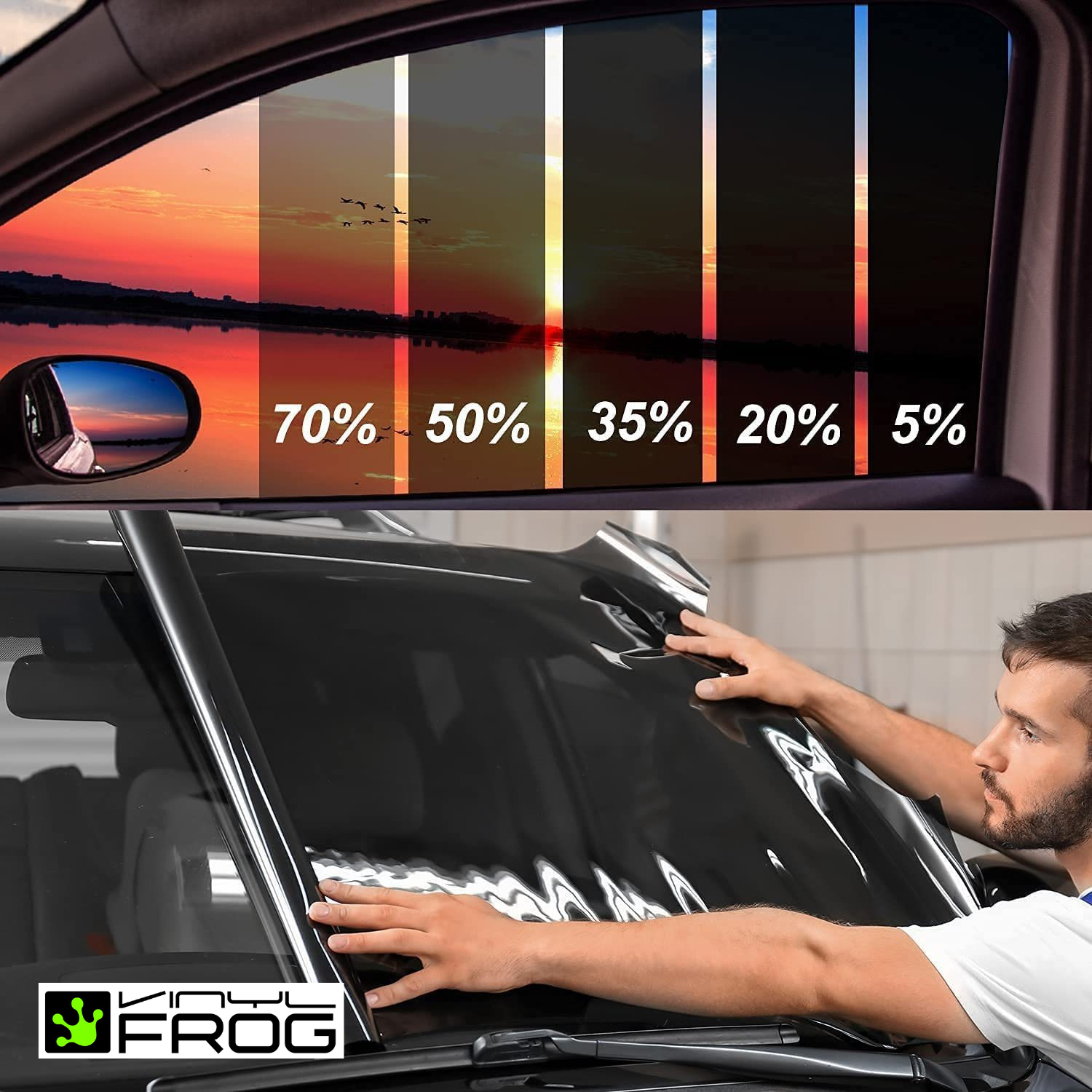
Tint shades are measured in VLT, visible light transmission. The number is the share of visible light that passes through the film. A lower number means a darker window. A 5% film is nearly black and a 70% film looks almost clear.
Factory glass already filters light. Most car glass transmits about 70% to 80% on its own, so a 35% film on that glass reads darker than 35% on a meter. Keep that in mind when a law names a number. Our window tint percentages guide walks through every shade with photos.
| Film VLT | What it looks like | Where it is used |
|---|---|---|
| 5% | Limo black, nearly opaque from outside | Rear windows only in most states |
| 10% | Deep black with a little more light at night | Rear windows and privacy builds |
| 15% | Very dark, still shows a little of the cabin | Rear windows where darker film is allowed |
| 20% | Where privacy starts, close to factory privacy glass | The most popular rear shade |
| 25% | Medium dark | Rear sides in most states, front sides in a few |
| 30% | Tinted but not blacked out | Front sides in some states, rear anywhere |
| 35% | Clearly tinted, occupants still visible | The most requested shade overall |
| 40% | A medium smoke that keeps the cabin bright | Front side windows where allowed |
| 50% | Light smoke | Front sides in states with a 50% limit |
| 70% | Nearly clear | Front sides and windshields in strict states |
Most drivers mix shades. A darker film at the back for privacy and a lighter one up front to stay legal and keep night visibility. If you are stuck between the two most common choices, read 35 percent vs 20 percent. The rear glass has its own rules and its own defroster grid, covered in back window tint. Blackout film is explained in 0 percent window tint.
Window Tint Laws

Every state sets its own limits, and they follow the same pattern. Front side windows have the strictest limit. Rear side windows and the rear glass are usually allowed to go darker, and many states allow any darkness behind the driver if the car has two side mirrors. Windshields are limited to a strip above the AS-1 line, with a few states allowing a light film across the whole glass. Reflective and mirrored films have their own limits. Most states also allow darker film for drivers with a medical exemption.
The front side window limits below come from our state guides. Limits change, so open the guide for your state before you buy film.
- California, 70% on front side windows
- Pennsylvania, 70%
- New Jersey, no aftermarket tint on the front side windows at all
- Virginia, 50%
- Indiana, 30%
- Georgia, 28%
- Colorado, 27%
- Texas, 25%
- Oklahoma, 25%
The legal number is measured through the film and the glass together. If your car already has factory tint, a film that is legal on paper can read illegal on the meter. Meter the bare glass first, or ask the shop to.
What Window Tinting Costs

A professional job on the side and rear windows of a sedan runs $219 to $850 in 2026. The film type drives most of that gap. Carbon film runs $219 to $349 and ceramic film $319 to $499 at most shops, while top infrared films reach $850. Stripping old film first adds $99 to $299. The full breakdown by film and by vehicle size is in how much does window tinting cost.
If you do the work yourself, the film is the main cost. A 10 ft roll covers the side windows on most sedans. Getting two or three quotes is the easiest way to know what is fair in your area, and window tint near me explains what to ask a shop before you book.
Do It Yourself or Book a Shop

A skilled installer needs one to two hours for the side and rear windows on a sedan, or three to four hours with the windshield. SUVs and vans take longer because they have more glass and a more curved rear window. How long it takes to tint windows breaks this down by vehicle and film.
Tinting your own car is doable with patience, a dust free space and the right tools. Flat side windows are the easiest place to start. The rear glass is the hardest, because the film has to be heat shrunk to the curve, so plenty of people do the sides themselves and have a shop handle the rear. The steps in short.
- Wash the glass twice, including the seals and the bottom edge. Vacuum the interior so dust does not land on the film.
- Lay the film on the outside of the window with soapy water and cut it to size with a small margin.
- Spray the inside of the glass, peel the liner, position the film and squeegee the water out from the center to the edges.
- Tuck the edges, check for creases and leave the windows up for 48 hours while the film cures.
The full walkthrough with photos is in how to tint car windows. You will need a sprayer, a squeegee, a knife and a heat gun. Our window tint installation essentials kit covers the basics and the 13 in 1 window tint installation tool kit adds the heat gun. More tools are in the vinyl wrap tools collection.
Some vehicles bring their own questions. Glass roofs and signal sensitive electronics are covered in Tesla window tint, and curved marine glass in boat window tint.
Care, Problems and Removal

Keep the windows up for at least three days after the install. Do not wipe the inside of the glass for a week. After that, use only ammonia free cleaners on the film. Ammonia attacks the adhesive, and months later the edges turn purple or cloudy.
A slight haze right after the install is normal. It clears as the water under the film dries, which takes a few days to a few weeks depending on the weather. Small water bubbles disappear on their own in one or two weeks. Air bubbles do not. How to remove bubbles from window tint shows how to tell them apart and fix the ones that stay.
Faded or purple film comes off with heat, steam or an ammonia soak. The method is in how to remove window tint. The sticky layer left behind has its own guide, how to remove the window tint glue. Never scrape the rear window, because the defroster lines sit on the surface of the glass.
Notes for Tint Shops
If you tint cars for a living, the film is only one part of the job. The prep decides the outcome.
- Prep the glass properly before you cut a panel. Road film, cleaner residue and invisible silicone survive a visual check and cause fingers that will not squeegee flat. Go over the glass with a razor scraper, then a clay bar and then a degreaser. Pay attention to the lower seal and side channels.
- Keep your slip solution working on hot glass. A warm panel shortens your working time, the adhesive grabs and the film stops sliding. An evaporation control additive buys you more time, and that time is what separates a first pass from a remake. Keep the bottle covered so it does not collect dust.
- Fix dot matrix silvering with the right process. The ceramic dot band around rear and quarter glass is raised, and film cannot make full contact with every dot. A thin slip solution runs off the dots, so use a tack solution across the band, squeegee with a hard card and finish with controlled heat. Set expectations before the install.
- Know your state limits. Keep a current reference sheet at the counter and ask the customer to confirm the legal limit before you cut. If they want darker than legal, put the refusal in writing.
- Send every customer away with three rules on a printed card. Windows up for three days. No wiping of the inside glass for a week. Ammonia free cleaners only.
Never tint a windshield below the legal line or apply film that reduces night visibility beyond what the driver can handle. Dark film looks good in the shop. On a rainy night it can hide a pedestrian.
Window Tint Film From VinylFrog

Every film in our automotive window tint film collection is nano ceramic. All six block at least 99% of UV, contain no metal and are rated for up to 8 years. They come on 5 ft wide rolls in lengths from 3.3 ft to 98 ft.
- 5% VLT Nano Ceramic. Limo black for maximum privacy. Keeps out 69% of the sun's heat (TSER).
- 10% VLT Nano Ceramic. Deep black with a little more light at night. Also rejects 69%.
- 20% VLT Nano Ceramic. Our most popular shade, close to factory privacy glass. Rejects 65%.
- 40% VLT Nano Ceramic. A medium smoke that keeps the cabin bright. Rejects 60%.
- 70% VLT Nano Ceramic. Light blue and close to clear. Rejects 49%.
- 70% VLT Advanced Nano Ceramic. The same light look with more cooling. Rejects 57.7% and blocks 99.8% of UV.
Not sure which shade fits your car? Order the window film swatch book and hold each shade against your own glass in daylight. Our best car window tint buying guide explains how to read a spec sheet and spot cheap film sold as ceramic. For the lights rather than the glass, see best headlight tint film and tail light tint.
Frequently Asked Questions
Q. How long does window tint last? A quality film installed on well prepped glass lasts for years. Dyed film fades sooner. Ceramic film holds its color and performance much longer, and ours is rated for up to 8 years. Installation quality matters as much as the film itself.
Q. Is darker tint always better for heat? No. Heat rejection comes from film construction, not darkness. A light ceramic film can reject more heat than a dark dyed film.
Q. What percentage is best? There is no single answer. 20% is the most popular choice for rear windows. For the front side windows, use what your state allows, which is usually somewhere between 40% and 70%.
Q. Can I tint over factory tint? You can, but the meter reads the film and the glass together. Film that is legal on its own can read illegal on top of privacy glass, and old film left underneath often bubbles. Check the bare glass first.
Q. Can I wash my car after tinting? Yes, on the outside. Wait at least a week before wiping the inside of the glass. After that, use only ammonia free cleaners on the film.
Q. Why does my tint look cloudy right after installation? A slight haze is normal while the film cures. It clears as the moisture under the film evaporates. This can take a few days to a few weeks depending on the weather.
Q. Will tint interfere with my phone or GPS? Dyed, carbon and ceramic films do not block signals. Metallic films can interfere with phone reception, GPS and toll transponders. Ask about film construction before you buy.
Q. Is window tint legal on the windshield? In most states only a strip above the AS-1 line is allowed. A few states allow a light film such as 70% across the whole windshield. Check your state guide.
Final Thoughts
Choose the film type first and the shade second. Ceramic gives you the most heat rejection at any darkness, so you can pick the shade by your state's law and how you drive at night instead of giving up comfort to stay legal. Get the prep right, give the film a week to cure and it will do its job for years. When you are ready, the films, the swatch book and the tools are all in the window tint collection.
- Choosing a selection results in a full page refresh.

!