
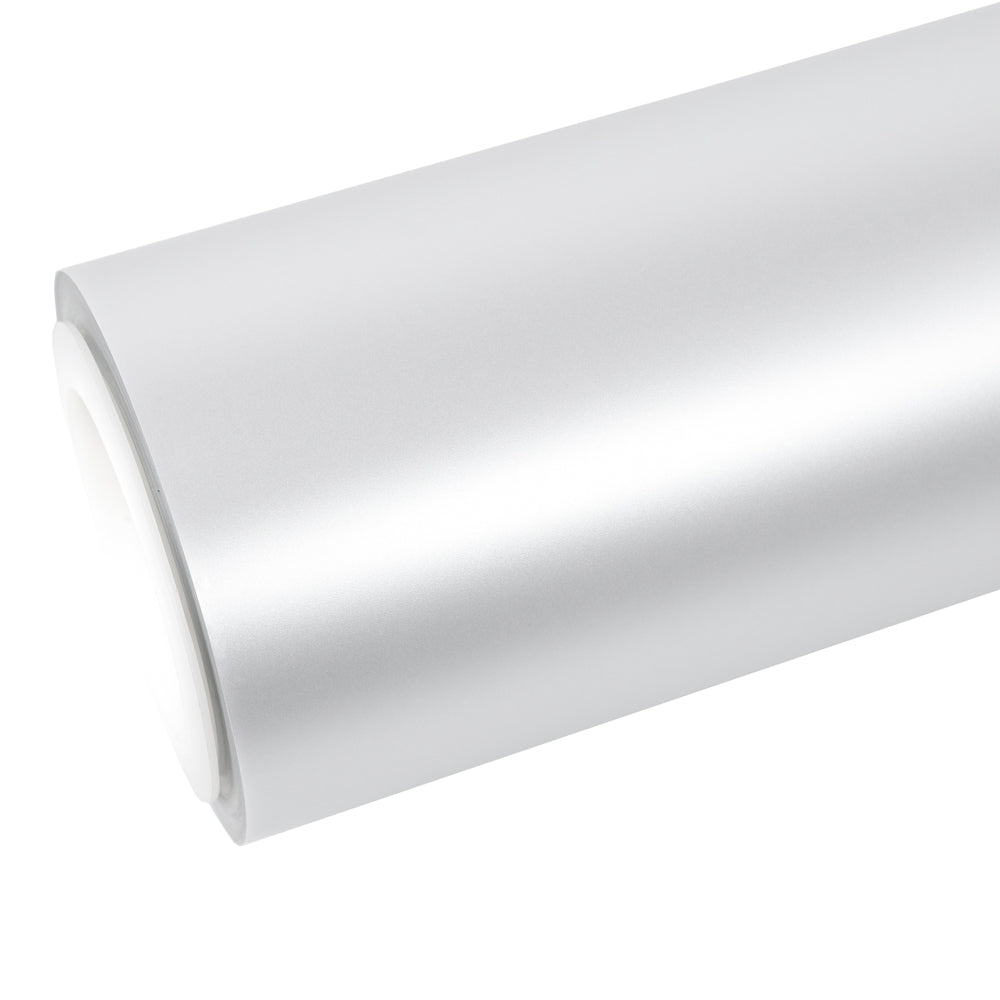
SKU: UM36D

Matte Pearl White Color PPF (Paint Protection Film)

Price
$999

Style: Dry Application

Size: 5ft x 49ft

How Much Vinyl Is Need To Wrap Different Type Of Vehicles


When you order vinyl wrap without knowing how much you need, you risk running short before finishing or wasting money on excess material. The exact amount depends on your car’s size, shape, and body style.

Most cars need 50–100 feet (15–30 meters) of vinyl for a complete wrap. Compact hatchbacks use less material, while larger sedans and SUVs require more.

How Much Vinyl You Need - Quick Guide

The table below shows the average vinyl length needed to wrap common car types using a 60-inch (1.52 m) roll

Car Type Vinyl Needed (Feet) Equivalent (Meters) Notes
Micro Car 25–30 ft 7–9 m Very small vehicles such as Smart Fortwo or Kei cars.
Mini Car 40–50 ft 12–15 m Compact city cars like the Mini Cooper or Fiat 500.
Compact / Small Hatchback 50–55 ft 15–17 m Popular models such as the Honda Fit or Toyota Yaris.
Coupe 50–60 ft 15–18 m Two-door vehicles with wider panels and sporty designs.
Mid-Size Sedan 60–65 ft 18–20 m Cars such as the Toyota Camry or Tesla Model 3.
Full-Size Sedan 65–80 ft 20–25 m Larger sedans with extended sides and roofs.
Hatchback 55–65 ft 17–20 m Compact models with rear hatches, e.g., VW Golf, Civic Hatchback.
Wagon 60–75 ft 18–23 m Longer body designs with extended rear sections.
Sports Car 55–75 ft 17–23 m Low, wide cars with complex curves and flared fenders.
Small SUV / Crossover 65–80 ft 20–25 m Compact SUVs with moderate height and curved body panels.
Large SUV / 4WD 80–100 ft 25–30 m Higher body panels and larger bumpers; requires more vinyl.
Pickup Truck 75–90 ft 23–27 m Includes tailgate, bed sides, and wheel arches.
Van 90–110 ft 27–33 m Large, flat panels ideal for commercial and branding wraps.


Pro Tip
: Always order 10–20% extra vinyl to allow for overlaps, stretching, and trimming, especially if you’re wrapping at home or working with curved panels.

Partial Wraps

A partial wrap covers only selected areas of a car instead of the entire surface. Common choices include the hood, roof, trunk, bumpers, mirrors, or side stripes. Partial wraps are ideal if you want to add custom accents, branding, or a two-tone finish without committing to a full wrap.

On average, a partial wrap uses about 30–50% of the material needed for a full wrap. That means you’ll typically need 20–50 feet (6–15 meters) of vinyl, depending on your car’s size and the number of panels you choose to wrap. Always measure each section carefully and add a small margin for trimming and alignment to avoid running short.

Factors That Affect Vinyl Usage

The numbers above give reliable estimates, but your exact vinyl needs can vary. Several factors influence how much material you should order:

  • Car Size and Design: Larger cars and vehicles with complex body lines require more vinyl. Curved panels, wide bumpers, and detailed edges increase surface area and trimming needs.
  • Wrap Type: A full wrap covers every painted surface, while a partial wrap only includes select areas such as the hood, roof, or accents. Naturally, partial wraps use less material.
  • Film Finish and Stretch: Different vinyl finishes vary in flexibility. Textured, metallic, and carbon-fiber wraps are thicker and less stretchable, which may increase waste during application.
  • Installer Skill: Professional installers use vinyl efficiently, while beginners should plan an additional 10–15% to allow for mistakes or trimming.
  • Body Accessories: Spoilers, mirrors, side skirts, and bumpers add extra surface area. Measure these parts separately to ensure full coverage.

How to Calculate Vinyl for Your Car

If you want a more precise estimate, use this simple method:

  1. Measure your car’s length and average height in meters.
  2. Multiply the two numbers to estimate total surface area.
  3. Divide the result by 1.52 (the standard roll width in meters).
  4. Add 10–20% for overlaps, curves, and trimming.

Example:
A sedan measuring 4.7 m long and 1.4 m high
4.7 × 1.4 = 6.58 m² ÷ 1.52 ≈ 4.3 m of film per side.
Double that for both sides, then add the roof, hood, and bumpers for a total of about 18–20 meters.

Practical Tips for a Smooth Wrap

  • Choose high-quality vinyl. Premium brands like Vinyl Frog offer consistent thickness and reliable adhesive performance.
  • Prepare the workspace. Wrap in a clean, dust-free area to avoid bubbles and debris.
  • Plan before cutting. Lay out each panel to reduce waste and ensure precise alignment.
  • Allow curing time. Give the wrap 24–48 hours before washing or exposing it to extreme conditions.

In stock and ready for shipping
American Express
Apple Pay
Google Pay
Mastercard
PayPal
Shop Pay
Union Pay
Visa

Product Description

A flat matte white wrap hides dirt but looks like primer. A glossy pearl white wrap shines but shows every fingerprint. VinylFrog Matte Pearl White sits right between them. It is a true TPU paint protection film with a pearlescent shade that shifts between cool ivory and soft silver. The finish is matte. No shine. No primer look. Just a silky surface that stays clean and hides imperfections.

The film protects your factory paint from road debris, stone chips, surface scratches, and harsh environmental exposure. Your resale value stays intact.

The hydrophilic coating does not let water bead and linger. Water spreads thin and slides off, carrying dust and residue with it. Fewer streaks. Fewer water spots. A self-cleaning effect with minimal effort.

Features

  • Smooth matte finish: a modern, low-gloss aesthetic that hides fingerprints and reduces glare

  • High-performance TPU material: durable and eco-friendly. No cracking or yellowing over time

  • Self-adhesive backing: strong acrylic-based adhesive for secure bonding to factory paint

  • Heat-activated self-healing topcoat: repairs light scratches and swirl marks with a heat gun, hot water, or direct sun

  • Hydrophobic surface: resists UV rays, stains, and environmental damage. Water and dirt wipe clean

  • Scratch-resistant and anti-corrosive: long-term paint protection against road debris, salt, and daily wear

  • Easy to apply, reposition, and maintain: adjust during install. Wash clean with matte-safe soap

 Specifications

  • Application Method: Dry Application.
  • Color: Pearl White.
  • Finish: Matte.
  • Sizes available: 5ft x 3.3ft, 10ft, 16ft, 33ft, and 49ft.
  • Packaging: Roll. 

Things You Should Know

Best Paint Protection Film (PPF)

How To Apply Paint Protection Film 

PPF Vs Vinyl Wrap

How Long Does Paint Protection Film Last?

How Much Does  Paint Protection Film Cost?

Video

Structure

Functions


Recommended Uses

▲ Standard Size & Appearance

Classification Unit Specs Remarks
Thickness Top protected film um 50±5% PET
Self-healing Layer um 10±5% /
Face Film um 60±3 Thermoplastic Polyurethane
Color Layer μm 17±0.5 /
Base Color Layer μm 70±0.5 Termoplastic Polyurethane
Acrylic Adhesive um 35±2 Solvent-based
Release liner um 75±5% Satin Semi-transparent White
Width m 1.52±1% 4.98ft
Length m 15±1% 49.21ft


Physical properties 

▲ General Properties

Features Test Method/Conditions Data
Gloss(60°) GB 8807 ≥90
Water Contact Angle DL/T864 Appendix A ≥90°
Hardness GB/T 6739 ≥85A
Elongation at Break GB/ T1040 ≥350%
Coating Elongation at Break GB/ T1040 ≥85%
Tensile Strength GB/ T1040 ≥18 (mpa)
Initial Adhesion FTM 9 ≥ 8N/25mm
24h 180° Peel Force GB/T 2792 ≥ 12N/25mm
Storage Aging Peel Force GB/T 2792 ≥ 10N/25mm
Application Aging Peel Force GB/T 2792 ≥ 16N/25mm
Peel Force GB/T 2792 ≤ 0.3N/25mm
Dimensional Stability (MD) FTM 14 ≤ 0.5mm
Dimensional Stability (CD) FTM 14 ≤ 0.4mm
Scratch Repair (0.1mm) Copper brush&Heat gun Repair Time≤ 3minutes
Stain Resistance GB/T 16422.2 No visible water stain deposits
Hydrolysis Resistance QC/T 1171-2021 stable for over 200h
Acid & Alkali Resistance Exposure to 10% hydrochloric acid and 0.1 mol/L sodium hydroxide solution for 24h No visual coating defects
Yellowing ΔE QUV Method 2000h ≤2
Application Termperature / +20℃ to +30℃
ServiceTemperature / -50℃ to +110℃
Recommended Shelf Life 15-25°C or 59-77° F and 45-50% Humidity 2 years
Warranty Period / 3-5 years


Warranty & Installation Guidelines

  • Warranty coverage: VinylFrog warrants each product meets its specifications at time of shipment. No other warranties, express or implied (including merchantability or fitness for a particular purpose).

  • Sole remedy: If a product does not conform, VinylFrog will either replace it or refund the purchase price.

  • Installation environment: Room temperature 25±3°C, humidity 50±5% RH, clean dust-free space with no visible airborne particles.

  • Installation steps: Inspect surface, clean thoroughly, cut film to size, apply without bubbles or lifted edges, clean excess solution.

  • Post-installation care: For one week after install, do not wash the vehicle or expose it to rain. This lets the adhesive fully bond.

Recommendations

Recommended application tools: Squeegee, buffer, knife, masking tape, heat gun, magnets, gloves, IRR thermometer, sprayer, towel, and installation liquid
Application method: Standard methods for Paint Protection Film. Do not overstretch and overheat. Post-heating is necessary.
Post-heating temperature: 110°C flat surfaces, 130°C curves and overlaps.
Aftercare: PH neutral. Avoid wax or solvents.

Durability:

The durability is based on South China exposure conditions. Actual performance life will depend on substrate preparation, exposure conditions and maintenance of the marking. For instance, in areas of long high temperature exposure and in industrially polluted areas or high altitudes, exterior performance will be decreased.

CAUTION!

 1. We will peel off the protection layer before shipment if your order is 1m,3m or 5m in order to make the vinyl good for shipping. 

 2. The images, colors, and finishes on the screen are approximate. For the real representation of the product always check the color swatch.

3. Most vinyl wraps are directional. Install the vinyl in the same direction across all panels. Applying the material in different directions can cause visible color differences due to light reflection.